Topics in this sectionMatter4 topics
States of matter
- Solid: Examples include stones, pens, paper, nails, and doors.
- Liquid: Examples include water, juice, alcohol, and tea.
- Gas: Examples include oxygen (O₂) and nitrogen (N₂).
Kinetic nature of matter
The kinetic theory explains the behavior of particles in solids, liquids, and gases based on their energy and arrangement.
i. Solids
- Particles are tightly packed, allowing minimal movement and giving solids a low kinetic energy.
- The electrons within each atom vibrate slightly, but the atoms remain fixed in position.
- Solids have a definite shape and do not conform to the shape of their container.
- Solids also have a definite volume and cannot be compressed.

Examples of solids
ii. Liquids
- Particles in liquids have more kinetic energy than those in solids and are not arranged in a fixed pattern.
- Despite being close to each other, liquid particles can flow around one another.
- Liquids have a definite volume but no definite shape, conforming to the shape of their container.
- Like solids, liquids cannot be compressed.

Examples of liquids
iii. Gases
- Gas particles are widely spaced and have high kinetic energy.
- If unconfined, gas particles spread out indefinitely. When confined, they expand to fill the container.
- Gases have neither a definite shape nor a definite volume.

Balloons filled with gases (air)
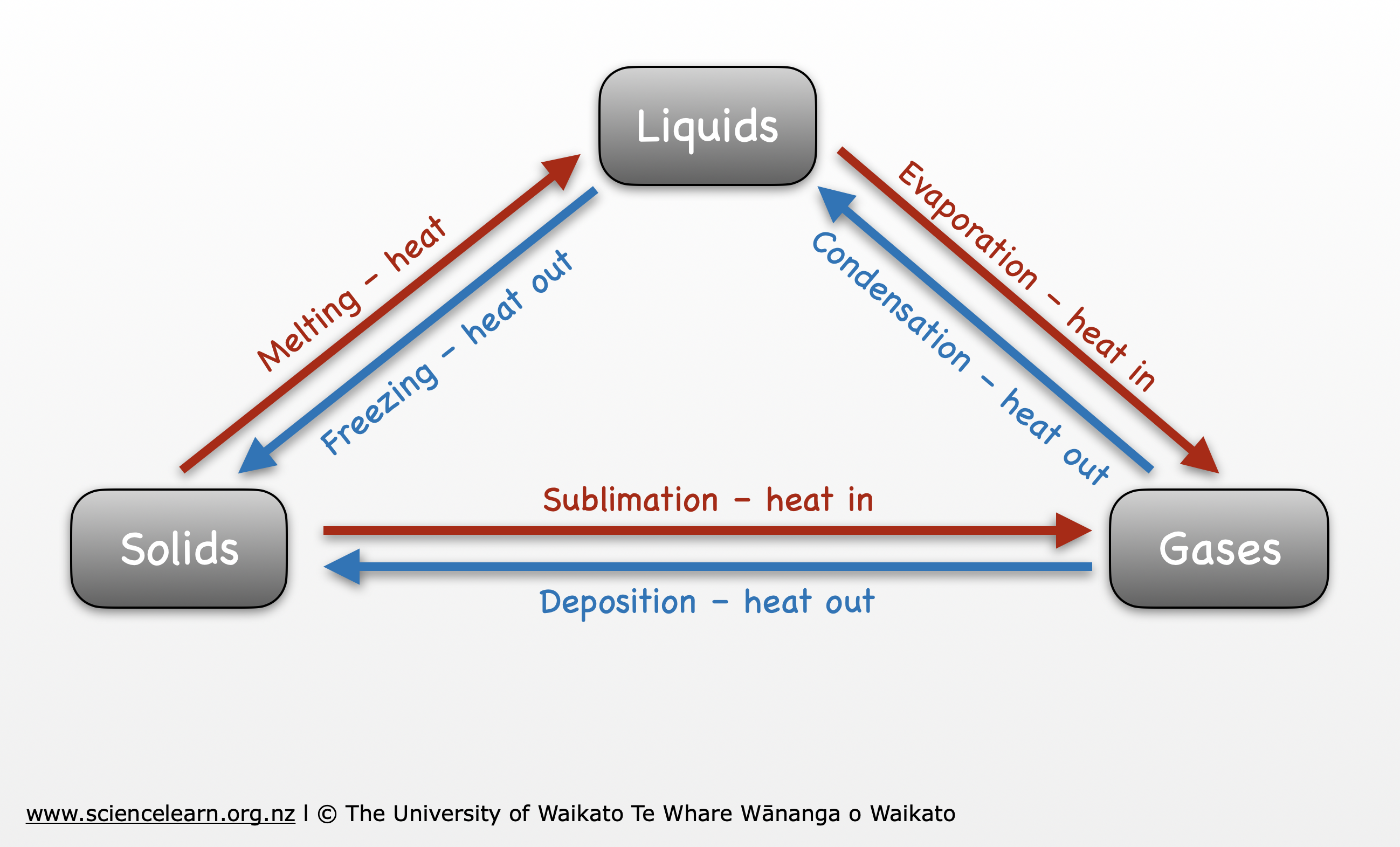
Relationships between the states of matter
- Melting: The process of changing from solid to liquid.
- Freezing: The process of changing from liquid to solid.
- Evaporation: The process of changing from liquid to gas.
- Condensation: The process of changing from gas to liquid.
- Sublimation: The process of changing directly from solid to gas.
- Deposition: The process of changing directly from gas to solid without passing through the liquid state.
Tutor
Reading this lesson? Ask me to explain anything in it.
Sign in to ask the Sonza AI Tutor about this topic.
Sign in to askDiscussions
No questions yet
Loading discussions…